From Edinburgh Flats to Pinewood Stages: Tracing the British Roots of Danny Boyle's Career
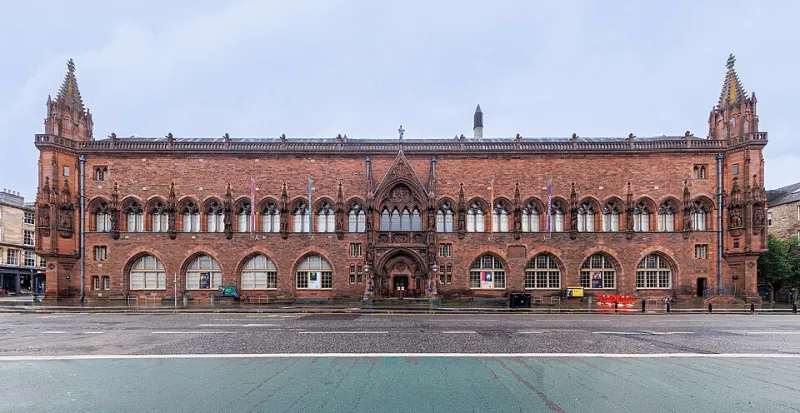
Photo: Kenneth C. Zirkel, CC BY 4.0, via Wikimedia Commons
Danny Boyle has always insisted that 127 Hours was, in many ways, the film he had been building towards for his entire career. A single location. A single performer. A refusal to look away. Those instincts were not formed in the canyons of Utah, but on British streets, in British studios, and in the margins of a British film industry that he helped redefine.
For the curious film lover, Boyle's Britain makes for a surprisingly practical pilgrimage. Nearly all of it can be done in a long weekend, and every stop tells you something about the director who would later ask audiences to sit through cinema's most notorious amputation scene.
Edinburgh: Where It All Began
No Boyle pilgrimage is complete without Edinburgh. Trainspotting (1996) turned the city's underbelly into a cinematic landmark, and while much of the film was shot in Glasgow and London, the Edinburgh connection remains spiritual and tangible in equal measure. Walk from Leith — the novel's home turf — up through the Old Town, and you are tracing the geography that gave Boyle his signature energy: grimy, kinetic, darkly funny, and utterly alive.
The Princes Street flat used in the film's opening is a genuine stop for devotees, and the city itself rewards the visitor with the same vertiginous contrast between beauty and squalor that made the film so electric. Boyle learned here that a location is never just scenery; it is a character with a mood.
London and the Big Canvas
Boyle's breakthrough came with Slumdog Millionaire (2008), but a curious footnote of that Oscar-winning production is how much of it was stitched together in Britain. Post-production, music recording, and significant studio work took place in and around London, where Boyle honed the film's propulsive rhythm in editing suites and mixing rooms far from Mumbai's streets.
It is a reminder that filmmaking identity is forged as much in the dark of a UK studio as on location. Boyle's collaboration with composer A.R. Rahman, refined in London sessions, gave Slumdog its heartbeat — and demonstrated the editor's-room discipline he would later need when his canvas shrank to a slot canyon barely three feet wide.
Manchester and the Northern Sensibility
Boyle was born in Radcliffe, Greater Manchester, and his early theatre work with the Royal Shakespeare Company and joint artistic directorship at the Royal Exchange Theatre in Manchester embedded a northern directness in his work. There is no plaque to photograph, but fans can visit the Royal Exchange itself, a stunning theatre-in-the-round where Boyle staged productions in the 1980s.
That theatrical grounding matters. 127 Hours is, at heart, a one-man stage play with a camera pressed against its subject's face. The lesson of holding an audience with nothing but presence was learned in Manchester rep, not Hollywood.
The Thames and the National Imagination
For a sense of Boyle at his most ambitiously British, consider his direction of the 2012 London Olympics opening ceremony — staged, fittingly, in the East London stadium that any visitor can tour today. Whatever one thinks of the spectacle itself, it showcased the same instincts that power 127 Hours: scale built from intimate human stories, humour threaded through tension, and a national audience held in one palm.
Why the Journey Matters
What emerges from this road trip is a portrait of a director whose most claustrophobic film was informed by the widest range of British experience — council flats and theatre stages, editing suites and Olympic arenas. Boyle's career is a map of modern Britain's creative life, and every stop is reachable by rail.
For UK film lovers, the itinerary offers something rare: a tour of a national filmography that ends, logically, at a film about a man who could not move at all. After a weekend on Boyle's home turf, 127 Hours plays differently. You see the discipline behind the intimacy. You see Britain in every frame.