Pilgrimage with a Pack: What Britain's 127 Hours Tourists Find in the Utah Desert
The image most British viewers carry away from 127 Hours is not a landscape. It is a wedge of rock, a trapped arm, a camcorder and a decision. Yet the film has produced a quieter afterlife in the travel plans of UK walkers: a slow, steady trickle of people who want to stand in the canyon that inspired Aron Ralston's ordeal. They are not arriving in coach parties. They are booking small guided trips, hiring cars from Las Vegas or Salt Lake City, and adding a detour to southern Utah between visits to national parks. In 2026, the pilgrimage is less a boom than a persistent murmur.
A Canyon That Fits the Mind, Not the Map
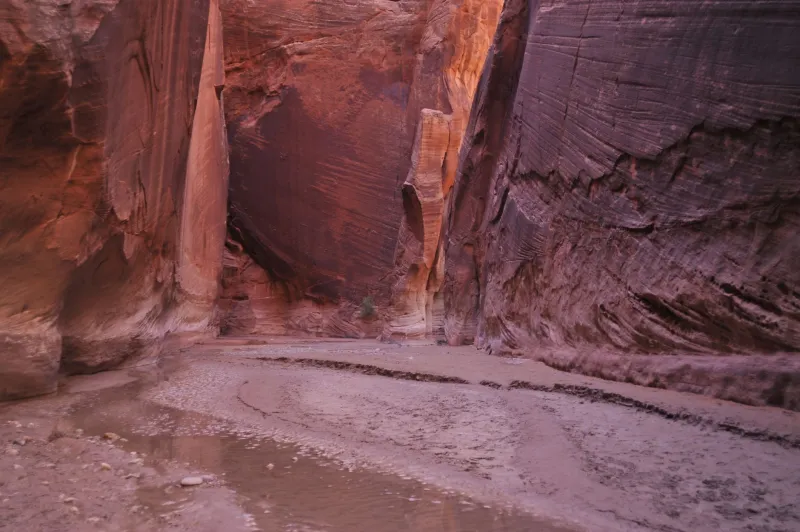
Blue John Canyon does not announce itself. It sits in a stretch of Utah desert where the roads are long, the mobile signal is unreliable and the scale is deliberately unhelpful. The canyon is not a single set-piece gorge but a network of narrow slots and open sandy stretches. Little Blue John, the tighter section familiar to filmgoers, can feel almost domestic in its dimensions — until a walker realises that the walls do not move for anyone.
Local outfitters in the Hanksville and Moab areas describe a recognisable pattern. British visitors often arrive with strong walking experience and a clear mental picture of the film's geography. What they lack, sometimes, is an equally clear picture of the desert's logistics: the drive times, the heat, the absence of shade, the need to carry more water than feels reasonable. Guides say the most useful service they provide is not technical instruction but calibration. The canyon is not a theme-park reconstruction of the film. It is a real drainage system that can flood, a real maze that can mislead, and a real place where a twisted ankle is more likely than a cinematic catastrophe.
The Guide's View: Small Groups, Long Memories
Commercial trips to the area tend to be small by necessity. Vehicles, permits and the narrowness of the slots keep numbers down. Guides report that British guests are often well prepared in terms of footwear and clothing, and unusually thoughtful about the ethics of visiting a site associated with a survival story. They ask about access, about the family's wishes, about whether the canyon should be treated as a memorial or a walk. Those questions are not always easy to answer, but they suggest that the film has done more than create curiosity. It has created a sense of responsibility.
The practical advice guides give is consistent. Go with someone who knows the route. Check the forecast for the wider catchment, not just the canyon itself. Carry a reliable form of communication and a plan for what happens if it fails. Tell someone outside the group where you are going and when you expect to be back. These are not exotic demands. They are the same principles that underpin any day on the hills in Snowdonia or the Cairngorms, translated into a hotter, drier and less forgiving setting.
What the Film Gets Right — and What the Desert Does Not
Danny Boyle's film is celebrated for its claustrophobia, but it is not a navigation aid. The real canyon offers no soundtrack, no editing rhythm and no reassuring cut to daylight. The rock is not a prop. The weather is not scheduled. The route out is not marked by a camera crew.
British safety experts make a similar point. The skills that serve walkers in the UK — reading a map, pacing effort, monitoring the group, turning back early — transfer well. The assumptions do not. In Britain, a wrong turn often leads to a fence, a lane or a village. In the Utah desert, a wrong turn can add hours. Heat is a hazard even in months that feel mild by British standards. Water sources cannot be relied upon. Flash floods can arrive from storms that never pass overhead.
The film's most useful lesson may therefore be an unintended one. It shows a competent outdoorsman caught out by a single slip and a sequence of small decisions. That is not a reason to stay at home. It is a reason to treat the canyon as a place where competence includes humility.
Where Enthusiasm Tips into Risk
The line between pilgrimage and risk is not dramatic. It is usually a series of small compromises: skipping the guide to save money, starting later than planned, carrying one bottle fewer, treating the film's location as a checklist item rather than a full day's objective. Guides describe visitors who underestimate the approach walk, or who assume that the narrow sections will be short because they were short on screen.
The British context matters here. UK walkers are often used to dense path networks and relatively quick access to help. In remote Utah, help is not a phone call away in any dependable sense. Mountain rescue teams in the UK frequently remind the public that mobile phones are useful but not a substitute for planning. The same caution applies abroad, with extra force. A personal locator beacon is not a luxury in this terrain; it is a sensible layer of safety. A satellite communicator is not a badge of paranoia; it is a recognition that the desert does not negotiate.
The Quiet British Character of the Pilgrimage
What is striking about the British response to Blue John Canyon is how understated it is. This is not a fandom that gathers at a premiere. It is a scatter of independent travellers, walking clubs and small groups who fold the canyon into a wider American road trip. They compare notes on forums, ask about permits and swap advice about hire cars. They are drawn by the film, but they stay for the landscape.
That is probably the healthiest version of film tourism. The canyon does not need an audience. It needs visitors who understand that the story they came for is not an invitation to recreate the worst day of someone's life. Go with a guide, go prepared, go with time to turn around. The film is the reason many Britons first hear the name Blue John Canyon. The desert is the reason they should listen to it carefully.