Eyes on the Exit: The Neuroscience of Looking Away, Explained in a British Cinema Seat
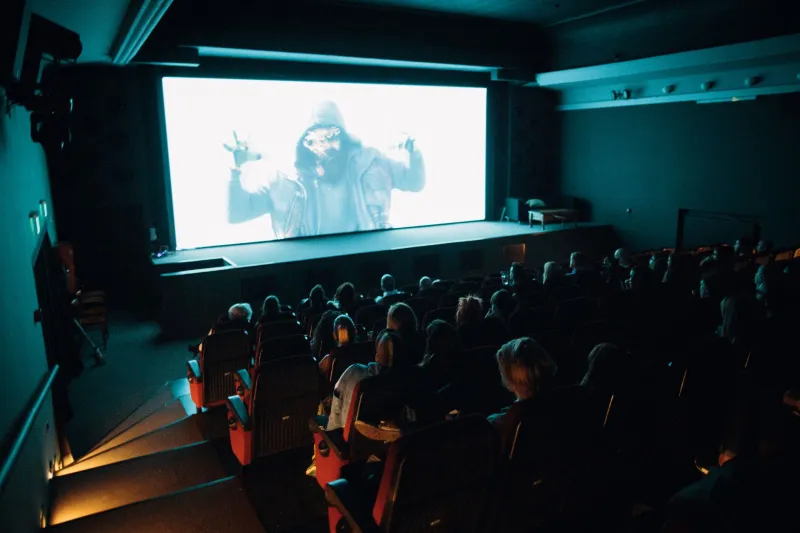
There is a particular kind of silence that falls over a British cinema when 127 Hours reaches its final act. It is not the hushed reverence of a prestige drama, nor the anticipatory hush before a jump scare. It is something closer to a held breath — a collective, involuntary bracing that projectionists across the country say they can set their watches by.
Statistically, UK audiences are among Europe's most composed. We do not whoop, we rarely applaud, and we apologise when we shuffle past your knees to reach row F. And yet, fifteen years on, this single film — ninety-five minutes of one man pinned to a canyon wall — continues to produce behaviour that no amount of stoicism can suppress: covered eyes, turned heads, and the quiet, dignified retreat of someone deciding they need a drink from the foyer right now.
The Stoicism Gap
Dr Helen Marsh, a behavioural psychologist at a London university who studies audience response to distressing media, describes what she calls "the stoicism gap".
"British cinemagoers have been socialised not to react outwardly," she explains. "We suppress the gasp, the flinch, the audible 'no'. But suppression is cognitively expensive. When a stimulus is sufficiently threatening — and a self-amputation, depicted with clinical realism, is precisely that — the more primitive systems win. Looking away is not weakness. It is the amygdala doing exactly what it evolved to do."
The amygdala, the brain's threat-detection hub, processes visual fear signals faster than conscious thought. By the time a viewer has decided to be composed, the reflex has already fired: pupils dilate, the body angles away, the hand rises to the face. In a Manchester screening Marsh observed, she counted fourteen audience members averting their gaze within the same ten-second window — none of whom had moved a muscle during the preceding hour.
What the Projectionists Say
If anyone knows the anatomy of a British audience's breaking point, it is the people in the projection booth. We spoke to three veteran projectionists, at independent cinemas in Sheffield, Bristol and Glasgow, and their accounts are strikingly consistent.
"You can hear it," says one, who has screened the film dozens of times since 2011. "The scene builds — the tourniquet, the dull knife — and there's this rustle. Not people leaving in droves, more like... repositioning. Coats adjusted. Then, at the break, a few seats empty. Always a few. They come back, mind. They always come back."
Another noted that the pattern holds across demographics. "Students, pensioners, lads who've clearly come for the gore — the gore lads are the first to look away, in my experience. Everyone thinks they'll manage it. Almost nobody does."
The Lecturer Who Screened It Anyway
Perhaps the bravest contributor to this piece is Dr Priya Nair, a film studies lecturer who has included 127 Hours in her undergraduate module on embodied cinema for six consecutive years.
"I warn them in advance. I offer an alternative text. Every year, a handful stay away, and every year, at least one student looks at the floor for the duration of the scene — and then writes the best essay in the cohort about it," she says. "That's the paradox. The scene works because the body resists it. My students who couldn't watch often understood the film's thesis better than those who could: that survival is not an idea, it is a physical event the mind struggles to witness, even secondhand."
Nair points out that Danny Boyle engineered this response deliberately — the sound design, the sudden shifts in light, the compression of time. "The audience isn't failing to watch the film. The film is succeeding at them."
Why It Endures
Fifteen years of streaming, second-screening and spoiler culture have, in theory, dulled our sensitivity to cinematic shock. Yet the amputation scene retains its power, and Marsh believes the explanation is simple.
"It is not a jump scare, which the brain habituates to quickly. It is sustained, escalating anticipation of a bodily event. That recruits a different, deeper circuit — one that doesn't habituate, because it is the same circuit that kept our ancestors alive. You cannot scroll past your own amygdala."
So the next time you attend a screening and watch a stranger in row H suddenly develop an urgent thirst, extend some compassion. They are not faint of heart. They are merely human — and, for a moment, so is everyone else in the room.